
"My vote doesn't really count."
How many times have you heard that? About a million times?
The idea that each of us has ONE vote is completely misleading.
The truth is, we as citizens really do hold the most power of anyone. The power of our vote is immense, and when I show you these numbers, you will be as blown away by them as I am.
"Only you know how you vote."
The "Secret Ballot" protects you from the influence of anyone else. This gives you the power to use your own mind and not be intimidated by all the noise out there trying to tell you how to think. Every vote decides just about every facet of life in the United States of America, from Washington, D.C., to your local City Commission. Your vote decides everything.
Nobody has to know how you vote.
You don't have to put up a yard sign. You don't have to discuss candidates. You don't have to argue politics at Thanksgiving. You don't have to tell your friends. You don't have to tell a political party. You don't have to tell me.
Come join me in discovering "Your Voting Power."
The citizen's vote is private. Its consequences are public.
Private Citizen > Secret Ballot > My Votes > Elected Representatives and Offices > Public Decisions > My Life.
You don't have "One" vote; you have many votes.
For 2026 in Bowling Green, Warren County, Kentucky, a midterm election...
I don't have 1 vote, but 22 votes!
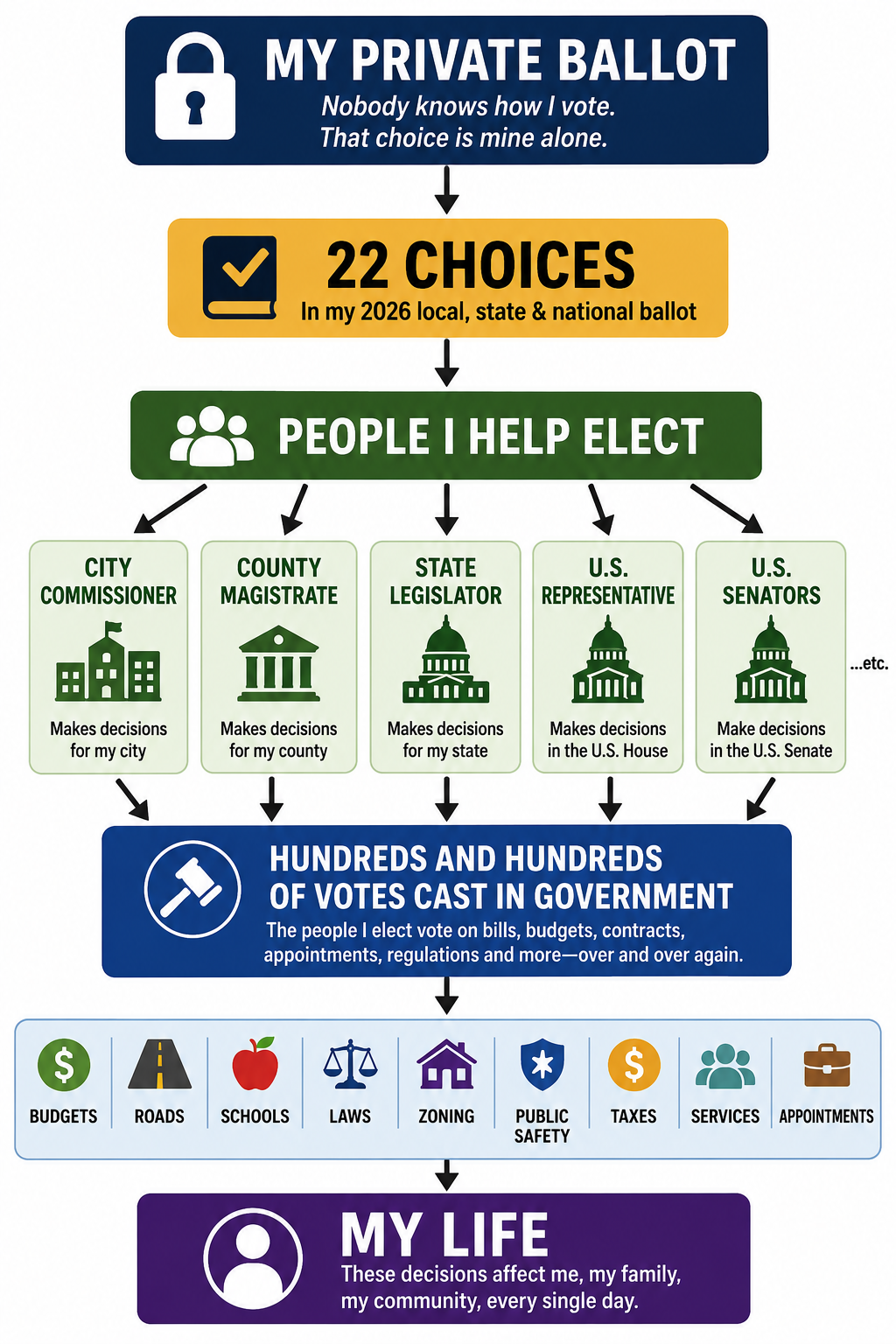
Here is a breakdown of all of the votes I can cast, and oh yes, we will also vote on a Kentucky constitutional amendment.
To remind you, those who serve in the local government, state government, and national government all have a direct effect on your life. Laws, ordinances, variances, policies, judicial appointments, law enforcement, school issues, community issues, and a lot more things get decided by people who are in those positions because they were elected to them. They are our employees. WE are the boss, not them.
This year, here is what I can vote for:
- US Senator (Statewide)
- US House of Representatives (District)
- KY Senator (District)
- KY House of Representatives (District)
- Circuit Court Judge
- District Judge (State/District)
- Property Value Administrator
- County Judge Executive (Like the Mayor of the whole county)
- County Attorney (Law enforcement - Public protection)
- County Clerk
- Sheriff
- Jailer
- Coronor
- Surveyor County
- Magistrate
- Constable
- County School Board
- BG School Board
- Bowling Green City Commissioner 1 (Max of 4 votes, but you don't have to vote for 4. Vote just for who you want.)
- Bowling Green City Commissioner 2
- Bowling Green City Commissioner 3
- Bowling Green City Commissioner 4
Now that is a lot of voting to do on one day of the year. That is a lot to understand. In fact, I'm betting a lot of people don't have a clue about what they do for us.
Here is the consequence of your 'little vote'. Plus, remember, this doesn't even include the Governor or Presidential races...
And Congress is only the top of the tree.
A state legislature adds perhaps hundreds or thousands more recorded decisions. A county fiscal court may vote dozens or hundreds of times annually. A city commission does likewise. School boards and other elected bodies add still more.
So if your question is really:
"After citizens elect their representatives, approximately how many subsequent votes do those representatives cast on their behalf?"
the answer is potentially enormous.
You cast ONE vote for a representative.
That representative may cast hundreds or thousands of votes during the term you elected them to serve.
In other words, your electoral vote isn't simply one decision. It helps determine who will exercise a stream of governmental voting power for the next several years.
Here is a breakdown...
I am a Bowling Green voter.
I cast:
ONE VOTE
for my city commissioner.
But that person participates in:
300+ governmental votes every year.
I cast:
ONE VOTE
for my county magistrate.
That person participates in perhaps:
300–500 governmental decisions annually.
I cast:
ONE VOTE
for my Kentucky representative.
That person participates in:
hundreds of legislative decisions.
I cast:
ONE VOTE
for my U.S. representative.
In 2025 that officeholder faced:
362 recorded House votes.
I cast:
ONE VOTE EACH
for my two U.S. senators.
In 2025, each Senate seat faced:
659 recorded Senate votes.
And we haven't even included school boards, judges, constitutional amendments, referenda, special districts, primaries, party nominations, committee voting, or many administrative bodies.
The officials a Bowling Green citizen helps elect collectively participate in well over 1,000—and plausibly several thousand—governmental voting decisions in an ordinary year.
Over four years, you're easily talking about thousands upon thousands of exercises of governmental voting authority downstream from the relatively small number of electoral votes the citizen personally casts.
Now how do you feel about your vote? You should see it in a completely different light.
Do you really want all of these decisions to be made without your say-so? I don't think so.
You are free
Nobody needs to know how you vote.
You are powerful.
You possess many votes, not one.
Your choices multiply.
The people you elect make hundreds of subsequent decisions.
You are protected.
Your ballot is secret.
The consequences aren't private.
Government's decisions affect everyone.
Your vote is private. Your voting power is enormous. And whether you exercise it is entirely up to you.
Our "Duty" as American citizens
America is the birthplace of modern democracy. We have a responsibility not only to ourselves as citizens and as a country, but also as world leaders, to demonstrate our participation in our own democracy.
People talk a lot about "Patriotism" and about "Serving our country," but there isn't much said about our duty to participate in our own government by voting in every election we can.
The percentage of people who can vote compared to how many are registered is embarrassingly low. The percentage of registered voters and those who actually vote are even more disastrous.
Out of 100 American adult citizens nationwide
74 registered to vote (74%)
11 out of those 74 didn't vote. (65% of all adult citizens voted)
35 do not participate in choosing the president. (35% didn't vote at all)
35% of the population of the USA:
236 million American adult citizens nationwide total. Some of those can't vote due to laws about felonies and such.
174 million are registered to vote. 62 million aren't even registered to vote!
Of those 174 million registered voters, 20 million didn't vote!
| Candidate | Popular vote | Share |
|---|---|---|
| Donald Trump (Republican) | 77,302,580 | 49.80% |
| Kamala Harris (Democratic) | 75,017,613 | 48.32% |
| All other candidates | ~2.92 million | ~1.88% |
| Total votes | 155,238,302 | 100% |
So, Trump won 1/3 of the vote; Harris won 1/3 of the vote...
...the other 1/3 didn't vote at all!
The numbers drop significantly when we look at the numbers for Mid-Term elections and off-year elections, in which the Kentucky Governor, Lt. Governor, Attorney General, and Treasurer are elected. The fact is, 1/3 of American citizens shrug off their duty to vote, and the more local the election, the more shrugging takes place.
Right now, your ability to vote is being tampered with. Powerful forces are at work to inhibit voters from voting. But, with 1/3 of the population not voting, that work is pretty easily done. 1/3 of the population is shooting themselves in the foot and undermining our democracy.
The truth is, we don't elect "People" to offices; we elect votes.
How many have fought throughout history for our right to vote and have an equal say as citizens? The only place where everyone is truly equal is at the voting booth. Don't let someone else take your vote.
Voting was first reserved only by white males who owned land, in England for instance. Then the USA allowed all white males the right to vote. It took well over 100 years to give women the right to vote, and that was not an easy fight to win. It took almost 200 years to give minorities the right to vote and the Civil Rights movement of the 60s cost numerous lives and a lot of turmoil to achieve.
Today, anyone who doesn't vote is a knife in the back to every sacrifice made by those who fought to give us this democracy.
Get to know your government
Get familiar with your government, the elected offices, and inform yourself about the candidates. I know there is a lot of work involved in that, and we all have busy lives. But, the decisions and actions of every one of those people deserve our input.
At the end of the day, who doesn't vote decides every election. That must stop, NOW!